Thursday, April 28, 2016

tiny marvels

Last June I attended the Town Library Plant and Bake Sale. It's a community event; contributors donate thinnings from their own gardens or flats of seedlings from their greenhouses.

One plant I chose was an epimedium.
I planted it at the base of a young oak tree surrounded by ferns, and by July it looked three times it's original size and seemed quite happy:

July 2015

In Autumn, it's leaves took on a semi-coppery sheen,
and when the "last" snow melted (quite recently, and possibly not the last at all), the remaining leaves looked like this:


As my world begins to green up, I've been keeping a close eye on the many, many places where I planted perennials last year, hoping for signs that the plants wintered well and will be back and thriving this year.

Last week, I was thrilled to find a glimpse of green at the base of that oak tree. A single stalk, elegantly arched over a cluster of deep pink buds:


And then another:


Just a few days later, there were more green stalks, unfurling, and many buds:


And now the first flower has opened!


I had to almost stand on my head for that picture, but I wanted you to get a sense of how threadlike these stems are, and how tiny the flowers. (In case it's not clear, those pink logs to the left are my fingertips.)

When I bought this plant, it was past flowering, so these flowers are a complete and wonderful surprise.

I have an illustrated list of many epimedium varieties, kindly given to me at a nursery last year. At some point, I will locate that list - probably when I am looking for a spool of thread or a screwdriver or a phone number - and then perhaps I can identify the plant with some certainty. Meanwhile, tentative identification: Epimedium alpinum 'Rubrum.'

Whatever it's botanical name, it's an unlikely-looking gem of a plant to appear and bloom at this changeable time of year. I'm thrilled to bits that it's back!

What happy returns have you found in your gardens this year?
~~~~~

Saturday, April 23, 2016

every day is earth day

(I started writing this "Earth Day" post last night and fell asleep with my hands on the keyboard. Fortunately for me, Earth Day comes around with each sunrise.)


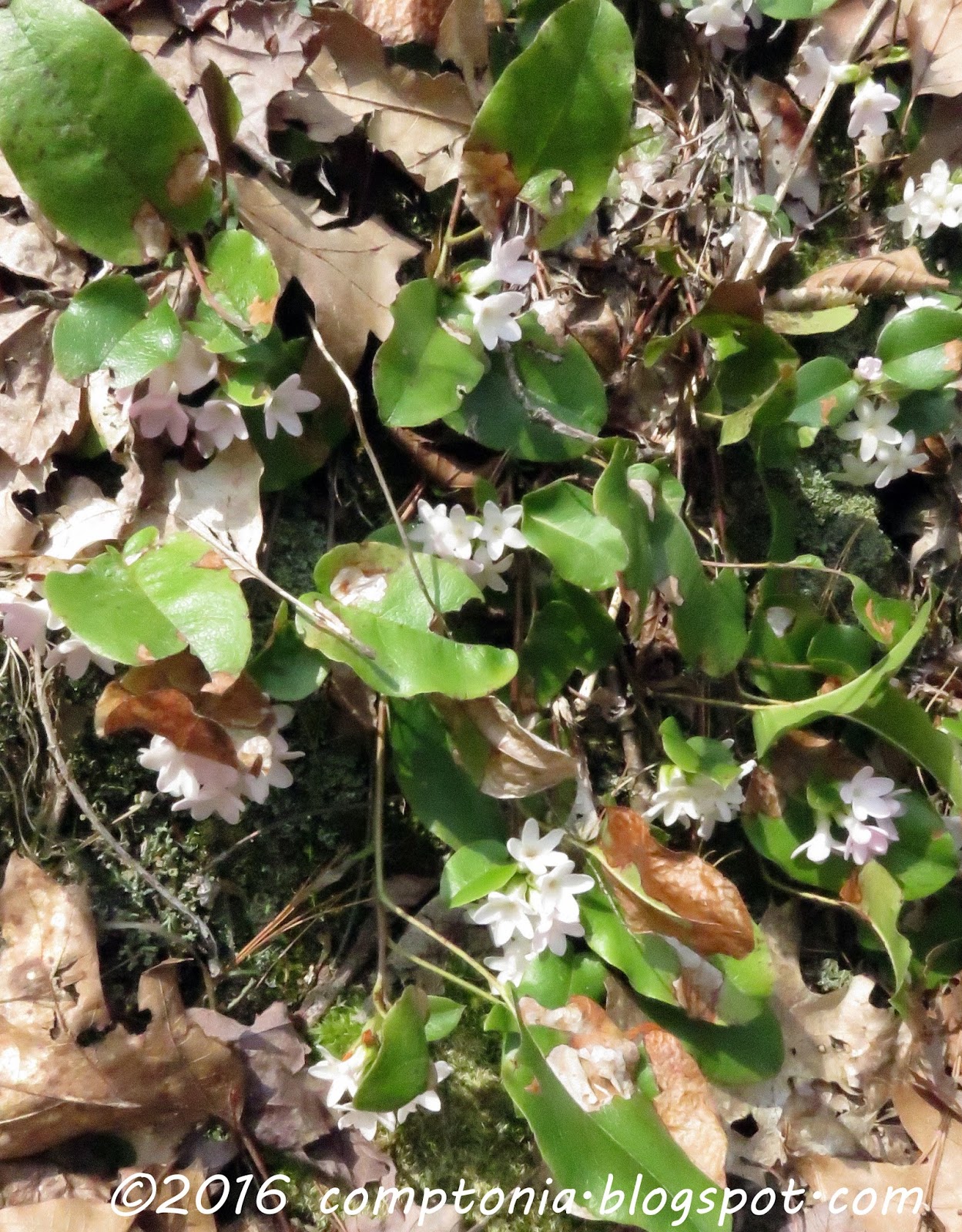
Epigaea repens
Trailing Arbutus
Mayflower

When I was little, I learned that this Spring-flowering gem is the official flower of Massachusetts, and that "picking it is Against The Law!" But only when I was about to post this picture did I realize I don't know exactly what that means. Is it Rare? Protected? Endangered?
So I fell down the google rabbit-hole, and wasted a lot of time on found a lot of contradictory "facts" and "history." The way you do.

Then I smartened up a little bit and visited the Massachusetts Legislature website to find the number of the existing law. Then on to the State Archives, to find the history of the law. The original law written in 1918 simply designated the mayflower "the flower or floral emblem of the commonwealth." This law was amended alarmingly soon; in 1925 the following language was added "as an emergency law, to prevent the extinction of the mayflower": 

Any person who pulls up or digs up the plant of the mayflower or any part thereof, or injures such plant or any part thereof except in so far as is reasonably necessary in procuring the flower therefrom, within the limits of any state highway or any other public way or place, or upon the land of another person without written authority from him, shall be punished by a fine of not more than fifty dollars; but if a person does any of the aforesaid acts while in disguise or secretly in the nighttime he shall be punished by a fine of not more than one hundred dollars.
~~~

I wonder what was behind the law being written in that way, don't you? Very belated Boston Tea Party backlash? 
~~~

There was a further amendment in 1953, which spelled out who has the authority/responsibility to enforce the law. Making me wonder if the law had ever been - or will ever be - enforced. Anyone looking for a Term Paper project in botany/history/law? There you go. Please share a copy; I'd love to read it.

Meanwhile, I'll be over here, enjoying this lovely little patch of Epigaea repens I happened upon yesterday. I don't see it often, so finding it blooming was a special treat.


p.s. Trailing Arbutus is very unlikely to survive being transplanted, as it relies on the presence of a specific soil fungus. Even if I was tempted to be a villainous arbutus-thief, I wouldn't risk it. Not even without a disguise.
~~~~~

Monday, April 18, 2016

in the shade


It was a tad warmish today, even in the shade.
Even in the morning.
Half the herd couldn't be bothered coming up to the barn for their breakfast buckets! There's often one or two who dawdle, hoping for Room Service, but this was unprecedented.
So I fed the "energetic" group their buckets, then split a bale of hay into flakes and distributed it across the Upper West Side. I usually do this in late afternoon, but reasoned that the decision to skip breakfast might be regretted long before then. I didn't want anyone getting hungry. And cranky. And thuggish.

 Speaking of hungry...
 With only a little thistle seed left in the sack, these goldfinches were having a hard time remembering to share. I added more seed, and soon there were three of four finches all eating together.

Here's a newcomer, who was not interested in the feeders
but was very interested in the handfuls of mixed seed I scatter on the ground:
I think this is a dark-eyed junco.
But I'm open to suggestions!


Now, here's one I know!
(Because I looked it up.)
It's a (rather stunning) white-throated sparrow:


In the picture below, the white-throated sparrow is atop the stump, way over on the right side. Can you see it? (Left-click to embiggen.)

But, look again!
On the ground, way in back.
Peeping around the root of the stump.
Can you see it?

It's this little bird: 

 Which is a chipping sparrow.
(Looked that one up also.)

I apologize for the quality of these images; they were taken from 10 - 15 feet away, with two layers of not-very-clean glass midway between the camera and the birds. But I decided to post them anyway, so I'll have a record of which birds are appearing, and when, this year.

These birdfeeders are attracting a lot of high-quality entertainment and I'm going to enjoy it as long as I can.
It won't be much longer, because with this warmer weather, will come the black bears. They never seem to forget where they once - and only once! - found a jackpot of sunflower seeds. I think they have a database.

This is the print of a bear who visited years after I stopped keeping a birdfeeder up in summer:

In case you can't make it out, here's the same picture with arrows pointing to the claw marks and a line at the base of the paw pad, in line with my own paw pad:


It wasn't a very big bear. But a bear doesn't have to be very big to get into trouble, and I like bears. I don't want to be part of the problem of bears - or any other wildlife - interacting with humans.

So I'll continue to feed the birds after the feeders come down, but only by scattering seed that will be eaten up quickly. Not so much leisurely snacking for the birds, or leisurely viewing for me.

On the brighter side, it will soon be time to put up the hummingbird feeders! Those stay up til autumn.

Gosh, I'm talking about birds and bears.
Spring. Definitely. Spring.
~~~~~

Saturday, April 16, 2016

sock interruptus

The latest pair of socks is taking quite a while.
Mostly because there have been entire weeks when I haven't picked up the needles. But now that the cashmere harvest is gradually beginning to wind down, other fiber-based endeavors can get some attention.


The past two days were warm enough that I could sit in the sun for a couple of hours (!) and savor every moment. A little knitting, a little reading, and enjoying the many birds calling and singing and tapping and hammering. They were so busy! Imagine if birds could knit. I'll bet their socks wouldn't sit, unfinished, for weeks. Not very likely.

Toward the end of Winter, when I came up with a possible way to deter squirrels from taking all the birdseed, I added a second birdfeeder outside the porch. It's the one in the picture below. The squirrel deterrent plan has been 90% successful, so this week I added a third feeder; just a little net bag full of thistle seed. With more types of feeder and seed available, there are more birds - and also more kinds of birds - visiting this Spring than I've ever had here before. It is wonderfully exciting!

Yesterday in one hour I saw chickadees, goldfinches, tufted titmice, nuthatches, purple finches, mourning doves, downy woodpeckers, phoebes, and a robin!

This is, I think, a pair of Purple Finches.


Why they are called "purple finches" is a mystery to me.
They are finches. But when the sun hits the male, he seems to light up with the dazzling color of pomegranate seeds.


Beautiful! But purple? They ain't.
Let's think of a more suitable name, shall we?

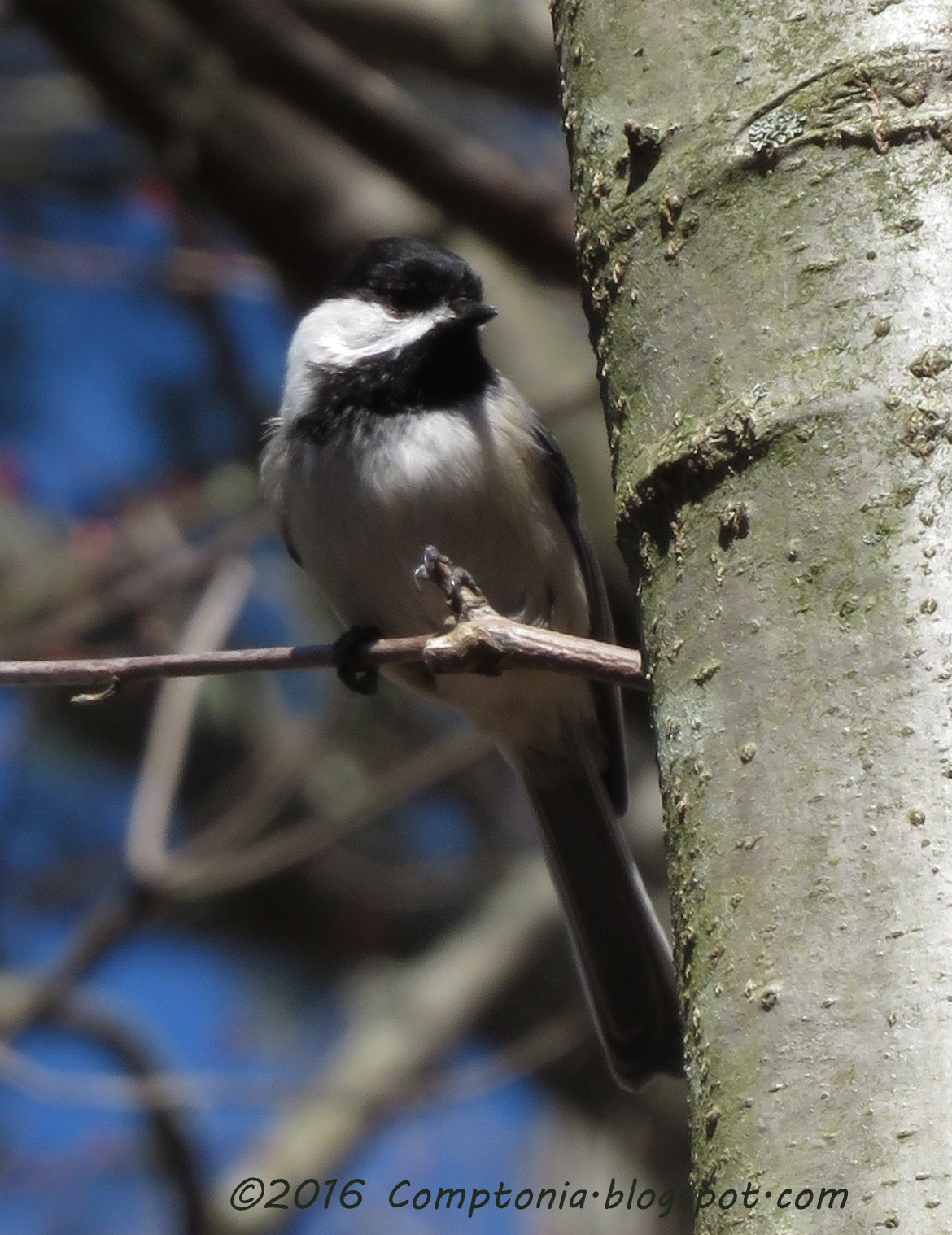
While you are thinking about it, here's a chickadee:


And here's sunlight making a momentary rainbow on a chickadee's wing:


And here's the heel of the second sock, well underway.
I decided to experiment in picking up the stitches for the gusset.
Sometimes it's tricky (for me) to be sure I'm picking up all the stitches in exactly the same way, because the edges of the heel flap curl in a bit.
So this time I ran a strand of purple yarn (THIS is purple!) through each stitch I would be picking up, before actually picking them up. Like a guideline. A path to follow. I will recommend this little experiment to any sock-knitters who feel uncertain about how to pick up their stitches for the gusset.


It's kind of fun to take a step back from something I've been doing for years, and figure out exactly how I am doing it. And maybe do it more consistently in the future as a result.

Or not! We'll see. These socks already have so many little weirdnesses, I will be forced to keep them for myself.
Heh.
~~~

I hope you are having a perfectly lovely Saturday, and the birds are singing wherever you are!
~~~~~